


Recently, Xinhua News Agency published a feature titled “Northeast China's 'National Heavyweights' Enterprises Accelerate Industrial Revitalization,” spotlighting how leading companies such as CRRC Changchun Railway Vehicles Co., Ltd. are driving regional growth through independent innovation, core technology development, and advanced equipment manufacturing. The report was published on the homepage of Xinhua News Agency's website and republished by over 30 mainstream newspapers and websites, highlighting the vibrant momentum of Northeast China's old industrial base in technological innovation and industrial upgrading.
On Xinmin Street in Changchun city, Jilin Province, a retro-themed cultural tourism train attracts the attention of passersby. The prominent "H₂" marking on its dark green body indicates its identity—this is a hydrogen-powered train.
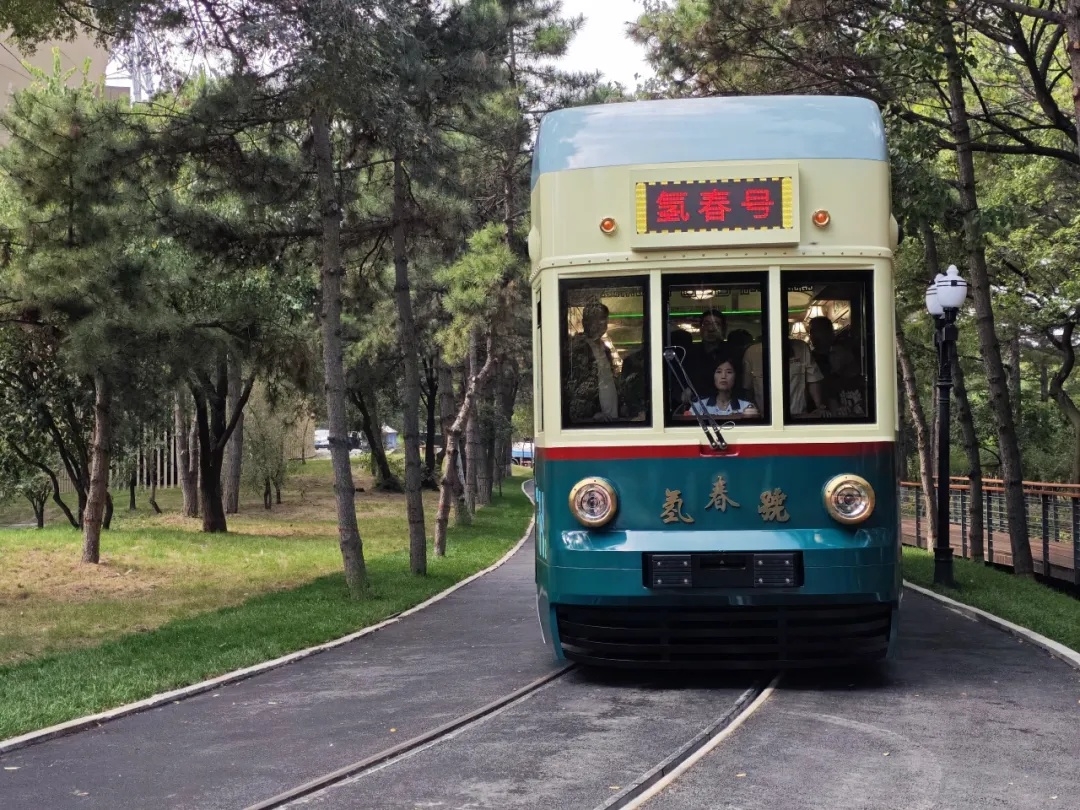
The train, named “Qingchun” (Youthful Energy), is a hydrogen-powered vehicle developed by CRRC Changchun. The train operates catenary-free operation or substations, relying instead on an onboard hydrogen power system. Its sole byproduct is water, achieving zero carbon emissions, with an average energy consumption of just 1.5 kWh per kilometer.
Compared to conventional internal-combustion-powered urban trains, each hydrogen-powered urban train can achieve a reduction of 50,000 tons of carbon dioxide emissions over its entire lifecycle, an amount equivalent to the total emissions generated by 50,000 automobiles each driving 5,000 kilometers, while consuming an average of merely 5 kilowatt-hours of electricity per kilometer," stated Shi Lei, a new energy designer at the Future Technology Research Department of the National Engineering Research Center for Railway Passenger Cars under CRRC Changchun Railway Vehicles.
While green transformation defines the foundation of these “strategic industrial equipment” enterprises, core technological innovation remains their competitive strength. The CR450BF high-speed train prototype-designed for an operating speed of 400 kilometers per hour and a test speed exceeding 450 kilometers per hour has entered the testing phase following its rollout.
CRRC engineers emphasized that the development process relied entirely on independent innovation, without any precedent to reference. Under the coordination of China State Railway Group, CRRC Changchun and its partners achieved breakthroughs in drag reduction, energy efficiency, vibration and noise control, and lightweight system integration. These advances have established the world’s first complete technological system for 400 km/h high-speed trains, encompassing theory, engineering, equipment, standards, and management.
Major industrial enterprises across Northeast China, a group of major industrial enterprises is leveraging green transformation, technological innovation, and digital empowerment to strengthen national strategic capabilities. Together, they are shaping a new development paradigm driven by new quality productive forces and accelerating the region’s comprehensive revitalization.
