


Recently, the Department of Science Popularization, China Association for Science and Technology (CAST) and People’s Daily jointly launched the themed feature “Witnessing the Path of Science and Technology.” As part of the People’s Daily – Science China series, reporters visited a wind turbine manufacturing base to document CRRC’s independently developed 20MW-class floating offshore wind turbine, “Qihang”.
Against the backdrop of the global energy transition, CRRC continues to strengthen China’s iconic “rail-on-wheels” high-speed rail brand while cultivating a second national calling card - wind power equipment as the “high-speed rail standing upright.”
When “Qihang” debuted at the Hamburg WindEnergy in 2024, it marked more than a showcase of technological transfer. It represented a deeper breakthrough in scale, efficiency, and system integration, setting the tone for a greener future.
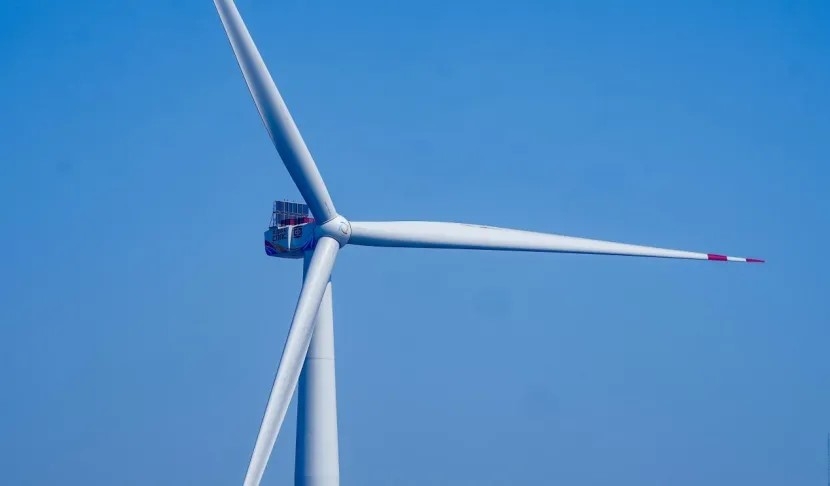
Independently developed by CRRC, the 20MW floating offshore wind turbine was successfully installed in Dongying, Shandong, in January 2025. With a rotor diameter of 260 meters—roughly equivalent to seven standard football fields—the turbine delivers approximately 3,500 full-load operating hours per year under design wind conditions. Each rotation can generate enough electricity to power a household for two to four days.
The turbine integrates a range of advanced control technologies and incorporates over 200 test points across blades, frame, drive train, tower, floating platform, and mooring system. These tests collect data on three-dimensional wind conditions, waves, six-degree-of-freedom platform motion, and component response curves, supporting comprehensive system validation.
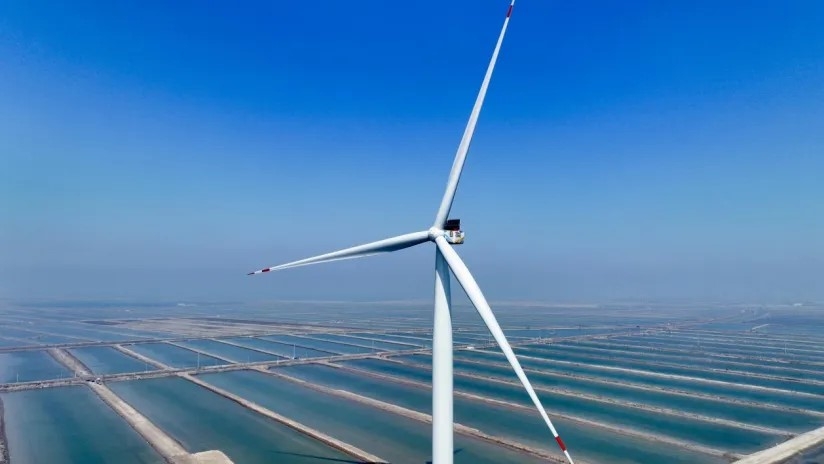
The ability of “Qihang” to operate stably in complex marine environments is underpinned by cross-sector application of advanced high-speed rail technologies, combined with structural and material optimization. Through innovations such as platform stability control, large-wave pass-through capability, and tilt-angle feedback, the turbine achieves dynamic balance and continuous power generation even under extreme sea conditions.
Addressing the long-term challenges posed by salt spray corrosion and harsh deep-sea environments, CRRC has implemented two core anti-corrosion solutions, enhancing material protection grades and structural impact resistance to ensure long-term reliability. Building on this foundation, engineers have further optimized energy capture and conversion efficiency, enabling the turbine to achieve truly adaptive power generation through intelligent control.
“Qihang” represents only the beginning. Looking ahead, through deeper cross-industry and cross-disciplinary collaboration, China’s high-end equipment manufacturing sector is set to advance toward a future that is deeper offshore, broader in scope, and more intelligent, contributing to global green and low-carbon development.
