


On November 21, CRRC’s ultra-high-power onshore wind turbine—the “Lingfeng” model—was successfully installed at the Zhangbei test site, marking a new milestone in CRRC’s wind-power deployment in China’s desert and Gobi regions.
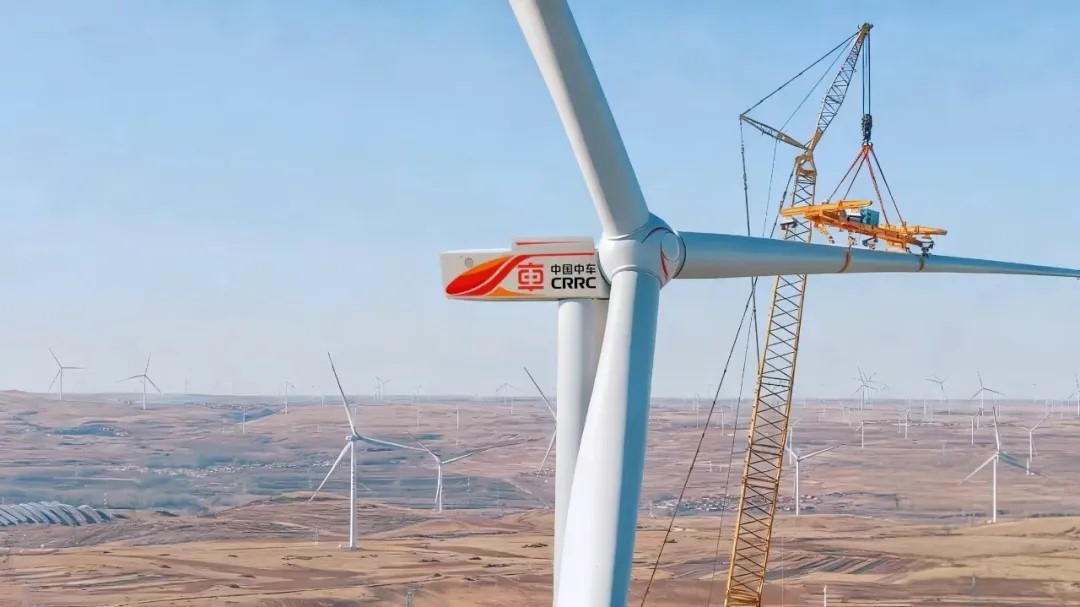
The “Lingfeng” turbine is a CRRC-developed platform designed for large clean-energy bases in desert–Gobi–wasteland areas, covering power ratings from 11-14 MW and supporting a rotor diameter of up to 250 meters. The prototype installed this time delivers 12.5 MW of capacity with a 242-meter rotor diameter.
At an average wind speed of 7.5 m/s, a single “Lingfeng” turbine can generate 38 million kWh annually, equivalent to saving 15,000 tonnes of standard coal and reducing 36,000 tonnes of CO₂ emissions, significantly improving wind-resource utilization in these regions. Preliminary estimates show that, under comparable conditions, its levelized cost of electricity (LCOE) is about 8% lower than that of a 10 MW turbine, offering strong economic advantages.
CRRC has long regarded high reliability as the lifeline of its wind-power products, embedding this philosophy across the entire lifecycle—from design and validation to manufacturing and O&M—and establishing a five-level verification system (grid, turbine, system, component, and materials).
The “Lingfeng” prototype has completed over 1,000 ground-based tests across four levels (excluding grid-level verification) and will next undergo full tower-based testing to further support high-quality design through rigorous reliability trials.
The turbine also enables single-unit intelligence and fleet intelligence, and features enhanced dust-proof sealing and surface-protection systems tailored to sand, erosion, and strong UV exposure in desert–Gobi environments. With strong grid-adaptation capability, it can operate stably amid complex grid conditions—such as large impedance variation, fluctuating loads, and intricate network structures—providing strong support for system reliability and stability.
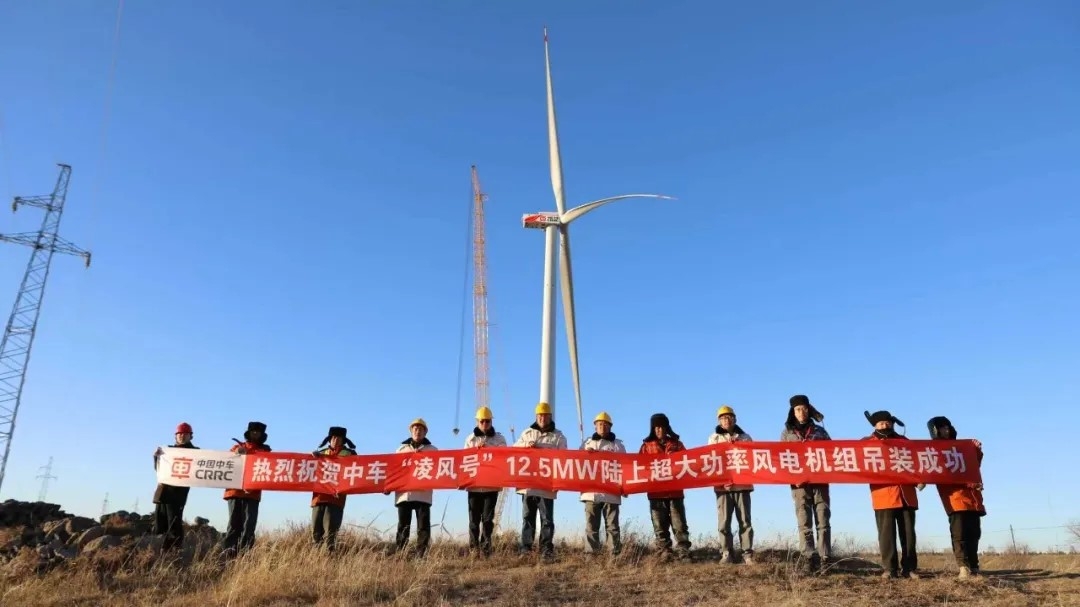
The successful installation of the “Lingfeng” prototype represents another important achievement in CRRC’s innovation journey and highlights the Group’s commitment to supporting China’s “dual-carbon” goals and advancing the “dual-track, dual-cluster” industrial development pattern. Looking ahead, CRRC will continue to innovate across diverse application scenarios, delivering efficient and reliable clean-energy solutions, improving renewable-energy utilization, and contributing to the optimization of China’s energy structure and the acceleration toward carbon-neutrality.
