


To promote scientific literacy, elevate the spirit of innovation, and support high-level technological independence and strength, the Science Popularization Department of the China Association for Science and Technology (CAST) has partnered with People’s Daily to launch the thematic report series “Witnessing the Path of Technology”. This series focuses on national science and technology strategies, major scientific awards, and critical “bottleneck” technologies, featuring in-depth interviews and research. It highlights compelling stories from the front lines of scientific progress, fostering a stronger national spirit of innovation and contributing to the growth of a technologically advanced nation.
With the ongoing development and application of digital technology, next-generation trains are emerging, including the 160 km/h hydrogen-powered regional trains, the “Fuxing” high-speed trains and high-speed maglev trains equipped with 5G technology and high-definition broadcasting studios for the “Beijing-Zhangjiakou” High-Speed Rail. These innovations position China as a global leader in rail transit technology.
As the birthplace of China’s high-speed rail, electric multiple units (EMU), and subway trains, CRRC Changchun Railway Vehicle Co., Ltd. (CRRC Changchun) has long been at the forefront of providing “Chinese solutions” to the global rail sector. But how does digital technology drive the transformation of train manufacturing? Recently, reporters visited Jilin Changchun to explore the company’s digital advancements.
Smart “Assistants” and Big Helpers for Cost Reduction and Efficiency Improvement
On the digital assembly production line for the bogie of CRRC Changchun’s rolling stock, the reporters observed digital intelligent tools such as production line dashboards, smart torque tools, smart monitoring systems, and intelligent tool cabinets. These tools are key components of the company’s efforts to improve manufacturing precision and efficiency.
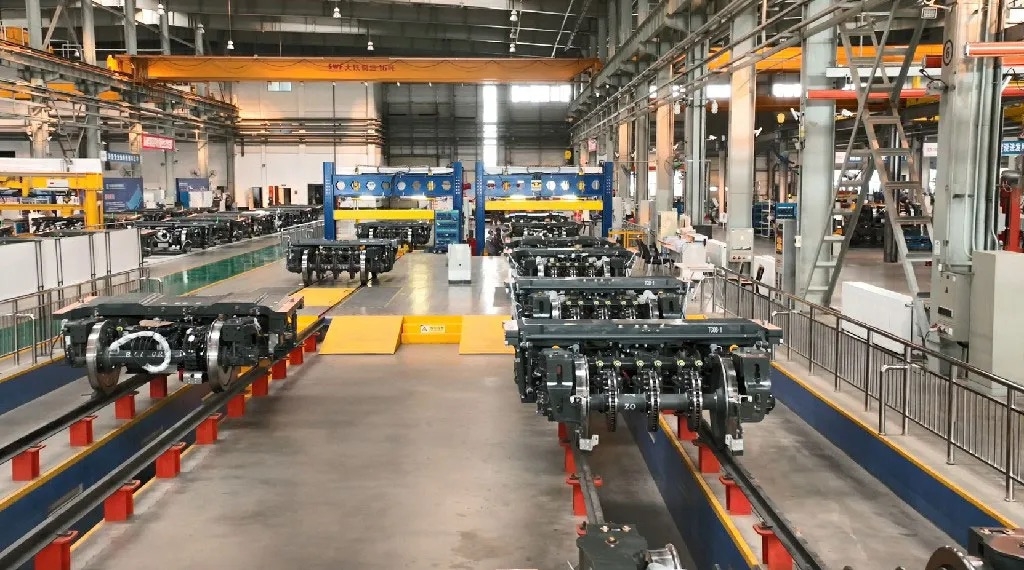
Li Bing, Deputy Director of the Engineering Technology Department at CRRC Changchun’s Engineering Technology Center, told reporters that the bogie, an essential component supporting the smooth operation of trains on tracks, plays a critical role in ensuring high-speed and stable train performance. “The bogie has hundreds of bolts, and in the past, manual tightening was time-consuming and labor-intensive and could lead to quality issues.” To address this, the entire production line adopted an intelligent torque system, issuing step-by-step operational instructions through structured process documents. Tightening records are automatically filled in, compared, and archived, effectively preventing issues such as missed installations, over-tightening, and insufficient torque, which significantly improves product reliability.
Additionally, to ensure product reliability, CRRC Changchun uses AI vision recognition technology combined with algorithms to monitor the compliance of key operations, replacing manual supervision.
The digital production line indicator board for the bogie is an important part of the production command cockpit. Every piece of data is instantly visible on the board. Li Bing explained, “Through the data center, we have achieved efficient integration of data across various platforms such as human resource management, manufacturing, energy monitoring, quality control, and materials management.”
“We have reshaped the business flow and data flow by combining artificial intelligence, big data, and the Internet of Things,” Li Bing continued. After the digital transformation of the production line, the company saves 30,000 tons of water, 5,000 kWh of electricity annually. The time for handling anomalies has been reduced by about 11%, and overall operating costs have decreased by approximately 20%. Furthermore, product quality has been significantly enhanced.
“Digital Doctor” Enables Full Lifecycle Health Management of Trains
At the Big Data Center of the National Railway Passenger Car Engineering Research Center, CRRC Changchun’s self-developed fault prediction and health management platform functions like a “digital doctor”, continuously monitoring the health status of trains in real-time.
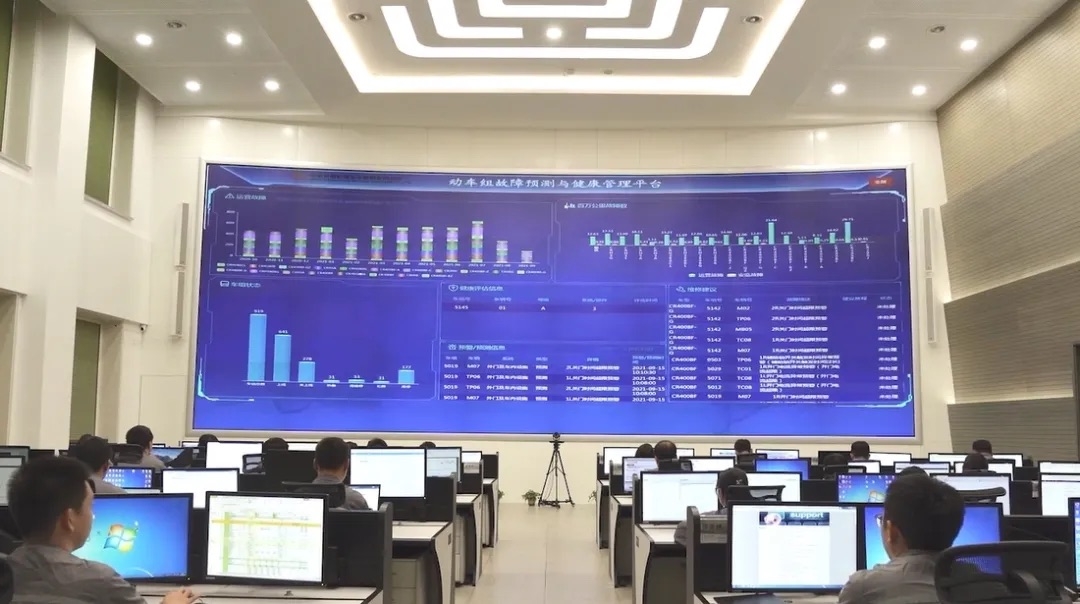
On the large display, four main sections—train overview, safety monitoring, operation and maintenance support, and data analysis—enable the trains to “communicate” through data, allowing for “timely intervention” even from hundreds of kilometers away.
The train overview interface provides real-time displays of key performance metrics, such as the number of trains produced and their operational availability. The safety monitoring interface detects alert-level faults in vehicles, guiding maintenance personnel to focus on specific issues during depot servicing. The operation and maintenance support interface leverages digital twin technology to visualize data analysis results and offer maintenance recommendations. The data analysis interface relies on big data, artificial intelligence, and computational models to perform statistical analysis, offering technical support tailored to the specific systems and types of trains.
Wang Lianfu, Senior Engineer at the New Technology Research Department of the National Railway Passenger Car Engineering Research Center, explained: “We can track fault statistics over hundreds of kilometers, and the fault rates are extremely low. This explains why our trains are becoming increasingly safer, and their on-time performance is improving,”
Digital transformation not only facilitates the tracking and monitoring of train operational status but also supports full lifecycle record management, contributing to iterative improvements in product design.
Du Qinghua, Deputy Director of the National Railway Passenger Car Research Center at CRRC Changchun, noted: “Based on systems engineering theory, CRRC Changchun has established a structured product development process, which covers everything from requirements to functionality, logic, structural design, and verification. This process has significantly improved the quality of product development, while also enhancing the efficiency of collaboration across different stages of the development cycle and enabling the dual delivery of both physical trains and digital models.”
“Industry-Data Integration” Powers Industrial Transformation
At its core, digital transformation is a systemic shift driven by digital technologies. It is not a simple enhancement or upgrade of isolated departments or processes, its primary objective is to fully integrate business operations, processes, organizational structure, and data into a unified system.
“At CRRC Changchun, we focus on industry-data integration, implementing process re-engineering and data governance. We have defined three categories of six-tiered processes, developed a comprehensive data governance system, established a data asset catalog, and created a data quality management model. Using algorithmic models and data visualization tools, we provide customized data analytics services for managers at various organizational levels,” explained Cheng Jihui, Assistant General Manager and Director of the Process and Digitalization Department at CRRC Changchun. “To date, we’ve completed the development of 62 data analysis interfaces and 924 indicators for operational performance and have begun applying data-driven insights.”
The digital transformation of rail equipment manufacturing represents a holistic renewal across multiple areas—production digitalization, raw material procurement digitalization, manufacturing process digitalization, logistics and distribution digitalization, as well as management and system digitalization. Beyond digitizing production lines and train operation and maintenance processes, China is exploring additional intelligent solutions to further enhance the intelligence of trains and improve the reliability and stability of train services.
